Most marketing plans fail for one reason
They are activity lists. Not operating systems.
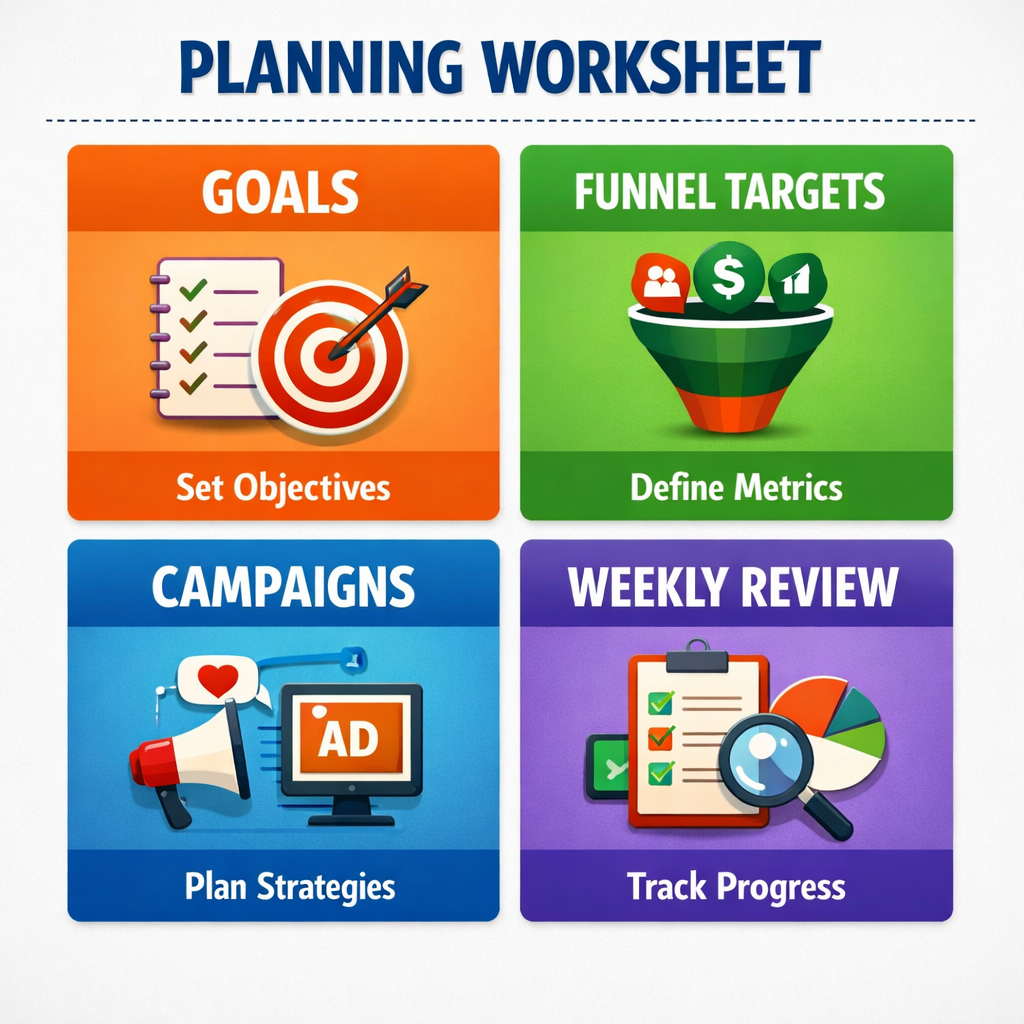
A real plan answers four questions:
- What outcome are you driving
- Who are you targeting
- What campaigns create the outcome
- How will you manage performance week to week
If your plan does not do that, it becomes a calendar. People stay busy. Results stay flat.
Step 1: Start with business goals, not marketing goals
Marketing exists to create revenue impact. Your plan should start with business targets.
Examples:
- Grow revenue from $20M to $24M
- Increase new customer acquisition by 15 percent
- Improve retention by 5 points
- Expand into a new vertical and create $2M pipeline
Write the target in one sentence. Then translate it into pipeline math.
Step 2: Convert goals into funnel targets
If sales needs $10M in closed revenue and your win rate is 25 percent, you need $40M in qualified pipeline.
Now tie pipeline to lead volume using your funnel conversion rates.
You need these conversion rates:
- Visitor to lead
- Lead to MQL
- MQL to SQL or opportunity
- Opportunity to closed won
If you do not know them, pull the last 6 to 12 months from your CRM and analytics. If data is messy, build a baseline and improve it over time. Do not wait for perfect data.
Outcome of this step:
- A monthly pipeline target
- A monthly opportunity target
- A monthly lead target
Step 3: Lock your ICP and segments
A plan without focus turns into random acts of marketing.
Define your ideal customer profile:
- Industry
- Company size
- Geography
- Buying triggers
- Primary pain points
- Buying committee roles
Then choose 1 to 3 priority segments for the next quarter. You can expand later. You cannot win everywhere at once.
Step 4: Define your offers
Campaigns need a reason to exist. That reason is the offer.
Examples:
- Assessment or scorecard
- Demo with clear outcome
- Webinar with a specific problem
- Case study tied to a use case
- ROI calculator
- Limited-time pilot program
A good offer is not “learn more.” A good offer gives the buyer a next step that saves time or reduces risk.
Step 5: Build campaign objectives that you can measure
This is where adults separate themselves from chaos.
Each campaign should have:
- Objective
- Target segment
- Primary channel
- Conversion event
- KPI target
- Budget and timeline
- Owner and supporting roles
Example campaign objective:
- Objective: Create 25 sales accepted opportunities in Q2 from Midwest manufacturing firms with 200 to 2,000 employees
- Conversion event: Booked meeting from landing page form
- KPI targets: 600 leads, 120 MQLs, 60 SQLs, 25 opportunities
- Channels: Paid search, LinkedIn ads, outbound sequence, partner email
- Budget: $30,000 media plus content production
Now you can manage it. Without this, you are guessing.
Step 6: Map campaigns to the funnel
You need coverage across stages. Most companies over-invest in top-of-funnel and under-invest in conversion and follow-up.
Use this simple coverage model:
- Awareness: reach and traffic to the right pages
- Consideration: offers that capture intent
- Decision: proof, case studies, comparisons, pricing clarity
- Conversion: landing pages, forms, meeting flow, follow-up SLAs
- Expansion: customer marketing, cross-sell campaigns, nurture
Every quarter, you should run at least:
- 1 demand capture campaign
- 1 demand creation campaign
- 1 conversion improvement initiative
- 1 customer expansion or retention campaign
Step 7: Build the execution plan
Now create the plan your team will live inside.
Include:
- Campaign calendar by week
- Asset list, landing pages, ads, emails, sales enablement
- Workflow map, lead routing, handoff rules
- Tracking plan, UTMs, events, CRM fields
- Reporting cadence
Make owners explicit. If “the team” owns it, nobody owns it.
Step 8: Set a weekly operating cadence
Monthly reporting is too slow. Quarterly reporting is fantasy.
Run weekly reviews with the same agenda:
- What shipped last week
- Performance versus targets
- Funnel conversion rates
- Sales feedback on lead quality
- Blockers and decisions needed
- Priorities for next week
Track three levels of metrics:
- Output metrics: emails sent, ads live, pages published
- Performance metrics: CTR, CPL, conversion rate
- Outcome metrics: meetings, opportunities, pipeline, revenue
Output matters, but outcomes pay your bills.
Step 9: Build a simple scorecard
Keep it tight. Five to ten numbers.
Example weekly scorecard:
- Website sessions from target segments
- Lead volume and cost per lead
- MQL volume and MQL to SQL rate
- Meetings booked
- Sales accepted opportunities
- Pipeline created
- Closed won influenced or sourced
When results dip, look for the first broken link in the chain. Do not jump to “we need more content” as a default response.
Step 10: Optimize based on evidence
Optimization is not vibes. It is controlled changes tied to measured outcomes.
Common high-impact optimizations:
- Improve landing page conversion rate
- Tighten targeting and exclude bad audiences
- Fix lead routing and speed to lead
- Improve follow-up sequences
- Add proof assets to decision stage
- Retarget high intent site visitors
If you raise conversion rates, you reduce cost. If you improve sales acceptance, you raise pipeline without spending more.
The bottom line
A marketing plan is a system. Goals feed funnel targets. Funnel targets drive campaign objectives. Weekly management keeps it on track.
If you want consistent performance, stop running marketing like a collection of projects. Run it like an operating rhythm.